

Every crisis leaves lessons behind.
In our monthly Crisis Series, Phoenix Resilience examines real-world events and the decisions that influenced their outcomes.
This month we are talking about Malfeasance.
The Crisis Series: Malfeasance
Monday August 3 2026
Who remembers the movie Robocop? In this old classic Dick Jones manages the Detroit Police Department and aims to transform it into a corporate utopia, prioritising financial gain and compromising safety.
It is an unfortunate fact of life that organisational malfeasance doesn’t only happen in films and television.
Unlike a simple mistake, malfeasance involves intentional wrongdoing where the person/team knowingly breaks the law, violates a policy, or causes harm to achieve organisational or personal objectives.

When individuals or groups inside an organisation conduct business in a way that violates laws, ethical standards, or societal expectations, they have become party to malfeasance.
These iniquitous actions appear in many forms. From intentional deception to unethical decision-making to the arguably less ethically unfavourable (but equally as damaging) unintentional failure of leadership.
It is enabled by systemic issues, such as misguided leadership priorities, questionable performance incentives, and a company culture that places economic profit over ethical principles.
The consequences can be devastating, including horrific financial losses, expensive drawn-out legal battles and unrecoverable reputational damage.
Malfeasance can be categorised as crises in:
- Skewed values
- Mismanagement
- Deception.
Studying how organisational wrongdoing occurs is important for two reasons:
- To understand how it happens.
- To understand how to prevent it from happening in the first place.
Skewed Values - The Enron Disaster
A crisis of skewed values occurs when an organisation prioritises short-term gains over integrity, sustainability, and basic ethical standards.
In the 1990s, Enron was celebrated as one of America’s most admired corporations, winning Fortune’s (an American global business magazine) Most Innovative Company award six years in a row (1996–2001).
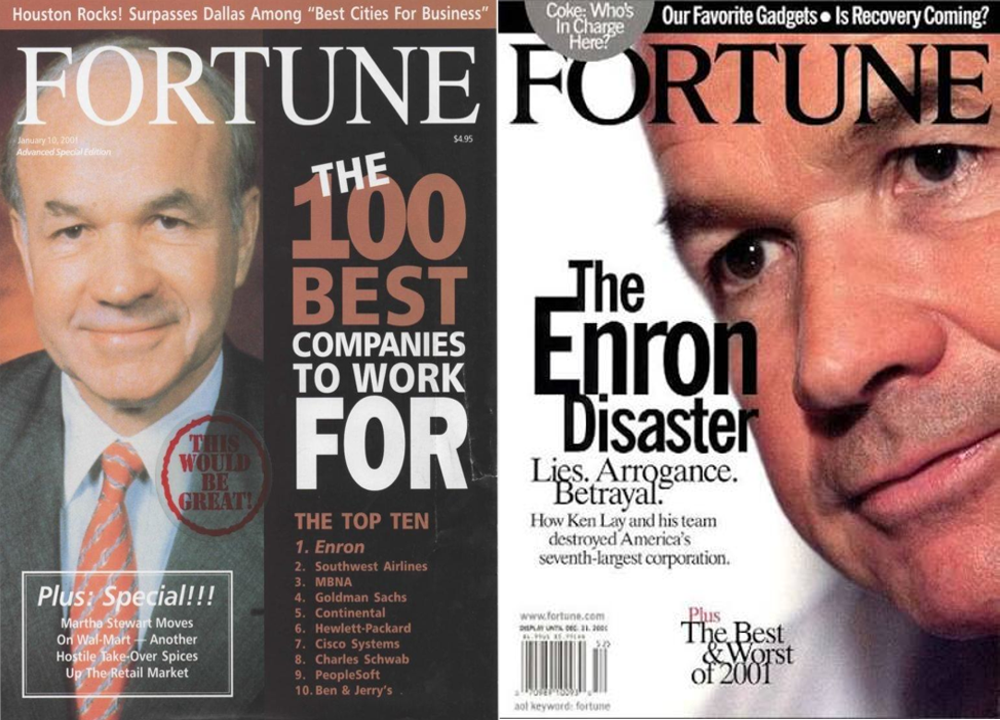
Behind the scenes, however, the company’s leadership had built a culture that worshipped growth, share price, and executive bonuses above everything else.
The company’s infamous “rank and yank” performance review provides a clear example of this. Employees were pitted against one another in forced rankings; those at the bottom were routinely fired. This created a hostile environment of internal competition where short-term results were everything. Honesty, collaboration, and long-term thinking became liabilities.
Under this pressure, deceptive accounting practices flourished. Debt was hidden, profits were exaggerated, and complex financial structures were used to maintain the illusion of success.
While outright fraud was involved, the source of the problem was cultural: financial performance had been elevated so far above ethical considerations that moral judgment collapsed entirely.
The illusion succeeded until whistleblowers and investigative journalists exposed the gap between Enron’s reported earnings and reality. The consequences were severe: thousands of employees lost their jobs and life savings, shareholders lost billions, and public trust in corporate America took a long-lasting hit. Enron filed for bankruptcy in December 2001, triggering major regulatory reforms and becoming a cautionary tale taught in business schools worldwide.
Business ethicist Joseph L. Badaracco Jr. argues that organisational pressures, incentive systems, and workplace cultures can distort individual ethical judgment. His research helps explain how employees within companies such as Enron may become involved in unethical practices when performance targets and organisational expectations override personal values.
Mismanagement - Deepwater Horizon

A mismanagement crisis arises when leaders lose control of core operations, safety, and risk, often through systemic failures in governance, coordination, and decision-making rather than deliberate wrongdoing.
The 2010 Deepwater Horizon disaster offers one of the clearest examples.
While drilling in the Gulf of Mexico, BP and its contractors disregarded multiple warning signs: abnormal pressure readings, flawed cement integrity tests, and known problems with the blowout preventer.
On a strategic level, there were deeper failures in risk management, communication across contractors, and safety culture under time and cost pressures.
Unlike crises driven by deliberate deception or skewed values, this was a story of governance breaking down.
Investigations by the US Coast Guard and Bureau of Ocean Energy Management, plus later independent technical reviews, revealed a chain of ignored risks and poor escalation processes. No single person set out to cause this catastrophe, yet the system was allowed to fail.
On 20 April 2010, an explosion killed 11 workers and triggered the largest marine oil spill in history, with nearly 4.9 million barrels of oil released over 87 days. The disaster fouled roughly 1,700 kilometres of coastline, devastated fisheries and wetlands, and killed or injured tens of thousands of birds, sea turtles, and marine mammals. BP ultimately faced more than $80 billion AUD in cleanup costs, compensation, fines, and settlements (The Guardian, 2018)
In the aftermath, BP suffered enormous financial losses, severe reputational damage, and years of regulatory scrutiny. In addition, major reforms to offshore drilling safety standards were enforced worldwide.
Sociologist Andrew Hopkins, an expert in organisational safety, argues that the Deepwater Horizon disaster resulted from systemic organisational failures rather than a single mistake. He identifies fragmented responsibility, ineffective safety management systems, and failures to recognise warning signs as factors that allowed foreseeable risks to develop into a catastrophic event.
Deception - Dieselgate

A crisis of deception occurs when an organisation deliberately lies to or misleads regulators, customers, and/or the public.
Few scandals demonstrate this more clearly the 2015 Volkswagen’s “Dieselgate” scandal.
Senior engineers and executives at Volkswagen were involved in the development and implementation of “defeat devices.” These were software installed in diesel engines that could detect when vehicles were undergoing official emissions tests and alter engine performance to produce lower emissions readings. Under normal driving conditions, however, many of these vehicles emitted pollutants far above permitted limits, misleading regulators, customers, and the public about their environmental performance.
This was not an error or failure of oversight. It was a calculated, systematic deception that allowed Volkswagen to market its diesel vehicles as environmentally friendly “clean diesel” while they were anything but.
The fraud was uncovered when researchers from West Virginia University and the US Environmental Protection Agency identified massive discrepancies between lab results and real-world performance. Once confronted, Volkswagen admitted the scheme. Approximately 11 million diesel vehicles worldwide were affected.
The financial cost exceeded $38 billion AUD in fines, settlements, and compensation (Reuters, 2017). The environmental toll was significant, with excess nitrogen oxide emissions contributing to air pollution linked to respiratory illnesses and premature deaths. The scandal triggered executive resignations, extreme reputational damage, and a lasting loss of public trust.
Unlike crises rooted in skewed values or mismanagement, Dieselgate was fundamentally about intentional, sustained misrepresentation.
When an Organisation does the Wrong Thing
When an organisation is responsible for wrongdoing, the priority must be immediate accountability and effective crisis containment.
Leadership needs to act quickly and decisively. This means publicly acknowledging the problem, providing a clear and honest explanation of what occurred, and committing to full cooperation with regulators and investigators. If leadership was involved, they must be replaced before further crisis management can occur.
Harmful practices must be halted immediately, evidence preserved, and transparent communication opened with affected stakeholders such as employees, customers, investors, and the wider public.
Those harmed deserve meaningful recompense, whether through compensation, refunds, remediation programmes, or other remedies.
Defensive responses or attempts to downplay responsibility almost always backfire, further damaging trust and drawing out the crisis.
Organisations should demonstrate responsibility through visible actions such as leadership changes where necessary, independent audits, and transparency about investigation findings and subsequent corrective measures.
These steps are important to rebuild company credibility and speed up crisis recovery.
How Organisations can Avoid Wrongdoing
To avoid crises of malfeasance, leaders should build strong ethical systems long before problems emerge.
This starts with including sound ethical values in the organisation’s foundations.
This can be achieved through well-structured leadership selection, performance incentives, promotion criteria, and daily culture.
Strong corporate governance is also important. This can include board oversight, strong internal controls, and regular external audits that evaluate financial performance and ethical conduct.
Risk management systems must be continuously reviewed and updated to identify blind spots and prevent operational breakdowns.
A speak-up culture, where employees feel safe raising concerns without fear of retaliation, should also be encouraged.
By combining ethical leadership, aligned incentives, transparent accountability, and independent oversight, organisations can significantly reduce the risk of misconduct and build the resilience needed for long-term success.
How can we Detect Malfeasance?
Many methods are now available to detect and report malfeasance.
Advanced technology and data analytics:
- AI anomaly detection: Software flags unusual behaviour patterns for example anomalies in transaction patterns, off-hours system access, or sudden changes to supplier banking details.
- Continuous auditing: Systems automatically scan record changes in real time rather than waiting for audit cycles.
- Communication monitoring: Compliance tools scan internal emails and chat logs for high-risk keywords related to suspicious behaviour.
Reporting channels:
- Anonymous hotlines: Independent, third-party hotlines allow employees to report suspicious behaviour without fear of retaliation.
- Whistleblower protections: Strong legal frameworks shield informants and encourage insiders with direct knowledge to speak up.
- Exit interviews: Departing employees often share insights into toxic practices or unethical behaviour they witnessed while employed.
Structural and internal controls:
- Separation of duties: Multiple people must approve high-value transactions so no single person has total control over money or data.
- Mandatory rotations: Forcing employees in high-risk roles (like purchasing or accounting) to take consecutive leave allows others to review their active files.
- Surprise external audits: Unscheduled reviews by outside firms prevent wrongdoers from cleaning up financial records in advance.
The Importance of Ethical Business Decisions
Understanding how to detect and prevent organisational wrongdoing is essential for maintaining legitimacy, stability, and public trust.
Crises stemming from skewed values, mismanagement, or deception can inflict severe financial losses, legal consequences, and lasting reputational damage, harming not only the organisation but also employees, customers, investors, and entire communities.
By studying major failures, such as Enron, Deepwater Horizon, and Dieselgate, organisations can identify systemic weaknesses and strengthen their governance, ethical culture, and operational controls before problems spiral out of control.
Organisations that include ethical values in their leadership, incentives, and culture decisions are less likely to cause harm in the first place.
In today’s environment of heightened public scrutiny and regulatory expectations, ethical decision-making and strong governance have become key drivers of sustainable success.
The ability to recognise, respond to, and prevent organisational wrongdoing is a fundamental requirement for long-term resilience and responsible leadership.
This article is part of Phoenix Resilience’s Crisis Series.
Join us on Tuesday, September 1, for our next instalment as we explore crises of nature and the lessons they hold for crisis leaders and organisations.
© Phoenix Resilience 2026